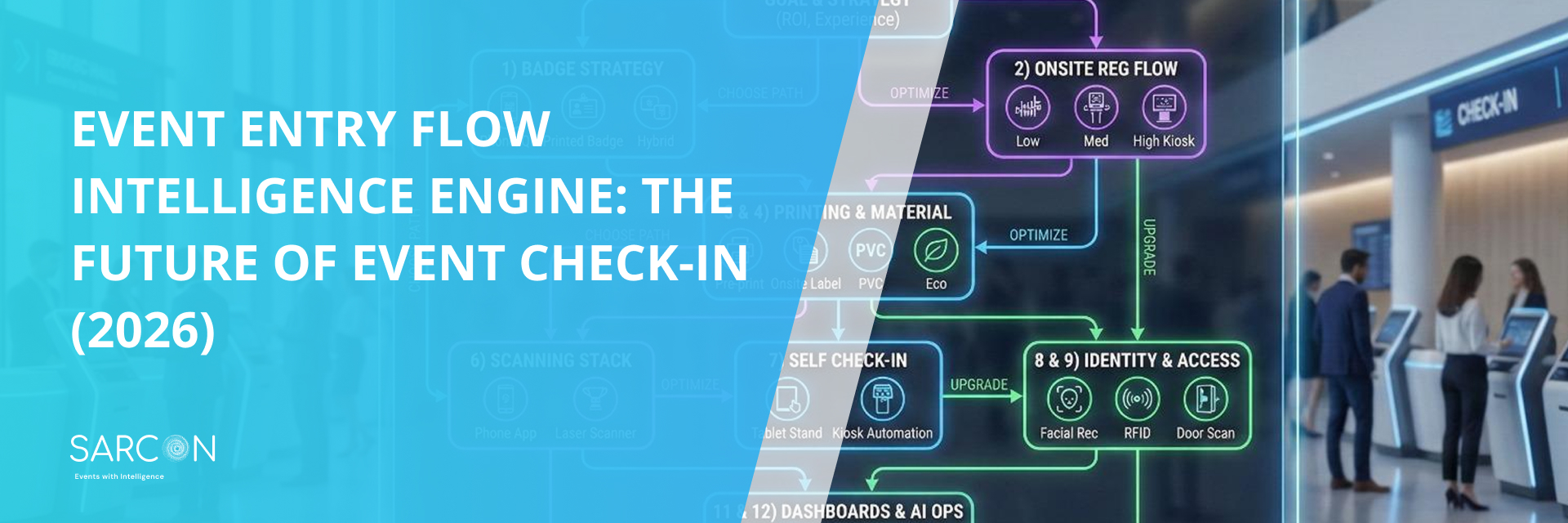
Event check-in has evolved. In 2026, leading teams aren’t just printing badges, they’re running fully optimized Entry Flow & Intelligence Engines. These systems plan, detect, act, and analyze in real time to elevate experience, efficiency, and ROI. Here’s what cutting-edge implementation looks like.
What Does a State-of-the-Art Event Entry System Look Like in 2026?
Forget “scan QR, print badge.” That’s just table stakes now.
The best events have quietly moved beyond check-in and are building what we call an Entry Flow & Intelligence Engine.
We’ve been in the trenches on thousands of events, and here’s what I’m seeing the sharpest teams start to do while most people do not even realize this layer exists yet.
1. It Plans the Entire Front Door Before You Land On-Site
A next-gen, AI-assisted setup does not ask, “How many counters do you want?”
It looks at:
- Expected attendance curves
- Venue layout and entry choke points
- Badge type and print method
- Onsite registration load
- Historical throughput data
Then it recommends:
- Number of entry, onsite registration, and print counters
- Where to place them
- Fast-lane logic for VIPs, exhibitors, speakers, and walk-ins
- Queue strategy and staffing suggestions
So you are not guessing and praying at 8:30 AM.
2. It Runs the Event in Real Time
- Registrations versus actual arrivals
- Expected check-in curve versus live data
- Throughput per counter, per minute
If arrivals are lagging, the system does not wait for a post-mortem.
It can surface alerts like: “Attendance is tracking 22 percent below expectation. Want to nudge no-shows right now?” with optional human approval before anything goes out.
3. It Detects Operational Failures Before Queues Explode
This is not science fiction anymore.
Mahakumbh 2025, the world’s largest event with 660 million participants over 45 days, used AI cameras to detect crowd surges, fire hazards, and barricade violations in real time. Alerts went directly to ground personnel to prevent stampedes that plagued previous editions.
- Printer issues such as ribbon, roll, driver, or jams
- Scanner or device issues
- Operator workflow confusion
The floor manager gets a clear action before people start tweeting.
4. It Proactively Protects Sponsor ROI During the Show
This is where entry data becomes revenue-critical.
- Blocked access such as coffee-line overflow
- Poor signage or dead-end placement
- Crowd bottlenecks near entry
Fixes can be operational or commercial, protecting renewals in real time.
5. It Creates Real Wow Moments Automatically
- Personalized welcome screens
- Instant alerts when VIPs arrive
It changes how the event feels in the first 10 seconds.
6. It Upgrades Identity Beyond Badges
Printed badges solved identity in the old world.
Facial recognition is now deployed across Southeast Asia, the Middle East, and North America with opt-in consent.
- Faster peak-hour throughput
- Stronger brand perception
- Cleaner attribution of who met whom, where, and when
7. It Measures What Actually Matters Instantly
- Session attendance and dwell time
- Spikes and drop-offs
- Movement across rooms and zones
Insights are surfaced during the event, not weeks later.
8. It Closes the ROI Loop in Your CRM
Entry, sessions, meetings, booth visits, and lead scans flow directly into your CRM, enabling real attribution and clear answers to whether the event actually worked.
Build the Engine Before AI Layers
Before deploying agents or intelligence layers, foundational setup is key:- Badge strategy
- Hardware reliability
- Counter logic
- Throughput mapping
Ready to Build Your AI-First Event Operating System?
Reach out to us for help. Or share this with someone still stuck firefighting check-ins.
This Entry Flow Intelligence Engine is one part of a larger AI-first Event Operating System. We’ve broken the full system down here: View the Full AI-First Event Operating System
FAQ
Q: What’s an Entry Flow & Intelligence Engine?
A: It’s a real-time, AI-enhanced system pioneered by Sarcon that manages check-in logistics,
detects failures, personalizes entry, and feeds insights directly into your CRM.
Q: Does this work for small B2B events?
A: Yes. The modular architecture makes it scalable for everything from
300-person summits to mega-expos.
Q: What tech stack is required?
A: An AI-first event platform like Sarcon that supports custom AI
and agentic flows for your events.
Key Takeaways
- AI-first event ops starts at the door.
- Entry engines improve speed, safety, personalization, and ROI.
- Real-time data fuels smarter decisions during and after events.