Quick Summary
Event teams are splitting into two camps: teams running on heroics, and teams running on systems that keep work moving after hours.
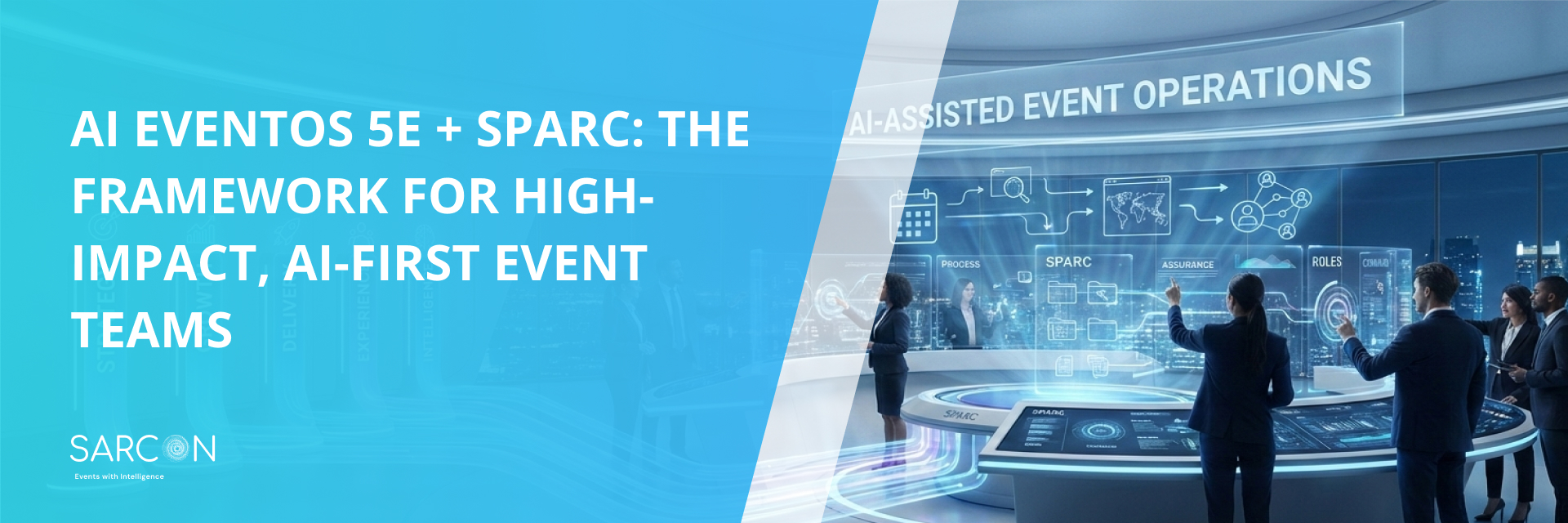
AI EventOS is the map: 5E (the engines that run your event) + SPARC (the controls that make it safe, scalable, and repeatable).
This post gives you the framework and proof. The implementation playbook can be accessed here Get Access: AI EventOS Framework Map + Deep Dive
What is AI EventOS
AI EventOS is an AI-first operating system for event organizations, pioneered by Sarcon and used by top event teams globally.
It combines 5E execution engines (Strategy, Growth, Delivery, Experience, Intelligence) with SPARC controls (Spine, Process, Assurance, Roles, Command) to replace last-minute scrambles with reliable workflows, faster follow-up, and safer live execution, while keeping humans in charge of high-stakes decisions.
Why this matters right now
Most event teams don’t have an “AI problem.” They have a throughput problem.
The demand hasn’t dropped. The timelines haven’t gotten kinder. But the expectation has changed: faster responses, cleaner execution, tighter ROI proof.
And the uncomfortable truth is the gap is already visible.
SaaStr publicly shared that AI agents now handle the majority of event execution, delivering roughly an 8–10× productivity lift per team member.
The cost shift, what used to be expensive is getting cheaper
A lot of “enterprise-only” capability used to come with enterprise price tags or headcount:
- Intent + targeting (big contracts, heavy ops)
- Organizers like Informa used intent data tools like Bombora, often starting around $50K
- Sponsor acquisition (SDRs chasing lukewarm leads, slow follow-up)
- Matchmaking (manual scheduling war rooms)
- Attendee support (temp staff, longer help desk hours, repeating the same answers)
Now, many of those outcomes are achievable with lighter tooling and tighter workflows.
Proof points:
- Western Veterinary Conference used a chatbot (“Rover”) and reported 11,000+ questions handled and 432 hours of attendee support.
- Clarion Events reported a 44% increase in meetings year-over-year with an AI matchmaking program.
- Our Indonesia client: Risk monitoring flagged unrest weeks ahead, giving time for contingency planning instead of last-minute panic
What “AI-first” actually means (no chatbot-in-a-corner)
When we say AI-first, we’re not talking about writing a few emails faster.
I mean workflows where software reliably:
- watches signals (intent, support volume, engagement)
- drafts outputs (comms, briefs, runbooks, reports)
- takes action (routes, schedules, opens tickets, updates CRM even make phone calls)
- escalates to humans when risk is high or context is missing
Humans stay in control. The default changes: the system pushes work forward.
The framework in one line
AI EventOS = 5E Core (the engines that run the event) + SPARC (the controls that make it scalable).
The 5E Core (the five engines every serious event team runs)
1. Strategy
What it runs: outcomes, scope boundaries, stakeholder alignment, change control.
Why it matters: most chaos starts as unclear decisions.
AI-first win: faster first-pass research and sharper alignment, so you don’t pay for it later in rework.
2. Growth (Demand + Revenue)
What it runs: audience acquisition, sponsor/exhibitor revenue, community loops.
AI-first win: speed-to-lead and follow-through that doesn’t stop at 6 pm.
A simple example: someone downloads your sponsor pack after hours.
Old world: they wait until morning and cool off.
AI-first: the system responds, qualifies, routes, and books time so humans spend energy on negotiation, not chasing.
3. Delivery (Production)
What it runs: speaker ops, vendor ops, support/comms, build/setup, onsite ops.
AI-first win: fewer missed dependencies, fewer “surprise” blockers, cleaner escalation.
If you’ve ever felt like you’re the human router between five vendors and three internal teams, you already know the pain.
4. Experience
What it runs: personalization, engagement, networking, sponsor value moments.
AI-first win: better matchmaking and “next best actions” that make the event feel intentional.
Clarion’s reported meeting lift is a clean illustration of what happens when matchmaking stops being spreadsheet-driven.
5. Intelligence + Optimization
What it runs: dashboards, forecasting, feedback loops, post-event follow-through.
AI-first win: detecting issues while fixes still matter, not in the postmortem.
Old world: you find out after the show.
New world: you catch issues mid-flight.
The SPARC Layer (why most “add AI” attempts collapse)
Teams try to bolt automation onto messy workflows. It works briefly, then breaks under bad data, unclear approvals, and live-event exceptions.
SPARC is the layer that keeps the system safe.
S = Spine (Event Data Spine)
Single source of truth: identity, segmentation, permissions/consent, and a knowledge base that isn’t trapped in people’s heads.
P = Process (Governance + QA)
Ownership, approvals, SOPs, QA gates, audit trails, change control.
A = Assurance (Risk + Safety + Compliance)
Monitoring external risk signals, routing issues early, and keeping humans in the loop when stakes are real.
R = Roles (Humans + copilots + agents)
Clear lanes and escalation rules, so you don’t end up with “automation that surprises you.”
C = Command (Event Command Center)
A control tower for execution: alerts, incident workflow, comms protocols, and postmortems that feed the next cycle.
Quick FAQ
What is AI EventOS?
An AI-first event operating system by Sarcon: 5 execution engines plus SPARC controls that make workflows safer, scalable, and repeatable.
What are the 5E engines?
Strategy, Growth, Delivery, Experience, Intelligence + Optimization.
What is SPARC?
Spine, Process, Assurance, Roles, Command. It’s the control layer that prevents automation from breaking in real-world event conditions.
Where should most event teams start?
Start with Spine + Process, then pick one engine that’s your current bottleneck.
Want the detailed playbook, templates, or help implementing AI EventOS?
Get access and join the AI Event Manager waitlist here: AI EventOS Framework Map + Deep Dive